Enjoy helpful home buying and selling tips as well as market updates, community events and local love.

Dec. 19, 2022

What you need to Know about Home Inspections

What you need to know about home inspections

What you need to Know about Home Inspections

You probably know that home inspections are often part of the homebuying process. But do you know why they’re so important — or what they mean for your home purchase or sale? Home inspections can play a big role in whether your homebuying (or selling) efforts are successful. Are you hoping to buy or sell a house soon? Here’s what you should know about how a home inspection might impact your goals.


Inspections aren’t required.

A home inspection is generally encouraged for buyers, but it’s not required. In a hot market, buyers might waive their right to an inspection to win a bidding war. But be careful: This could hurt you financially if you find yourself having to make large repairs and renovations.

The results can influence your deal — and your price.

If the inspector finds issues, the buyer will often want to renegotiate. They might ask the seller to make repairs before closing or offer a lower price point to account for them. If they have an inspection contingency, a buyer can even pull out of the deal without losing earnest money.

You have to pay for an inspection.

Home inspection costs vary by market and inspector, but they typically cost between $250 and $500 per property. Since the inspection is for the buyer’s benefit, they cover this cost out of pocket, usually as part of the closing costs.


Sellers sometimes get pre-listing inspections.

By getting one before the home hits the market, sellers can identify any problems that could hold back their sale. In many cases, sellers are required to disclose any issues their inspector finds if they haven’t been fixed.


If you’re preparing to buy or sell a home, get in touch today to start working with an experienced real estate professional.


Laurel Jonas

208-758-9000

208HomesForSale@gmail.com

208HomesForSale.com

Northwest Realty Group

Posted in Buying A Home Tips
Dec. 14, 2022

Home Office a Hot Mess? Let’s Fix It

Home office a hot mess? Let's fix it_Laurel Jonas Blog

No room got a tougher workout in the past year than the home office. And because of all the wear and tear, this space is probably ready for a little TLC. Plus, if you’re thinking of selling in the near future, potential buyers are certainly going to gauge this workspace with a critical eye.


Many of us continue to work from home, at least part of the time, which means the home office should be orderly, highly functional, and even attractive. Just don’t spend a ton when you go to rehab this spot.


To help you tackle this increasingly important space, here are five ways to give new life to your home office.


1. Update the chairs

Sure, you’ll have a desk and some storage space in your home office, but a small nook for deep reading or taking an extended Zoom call is also a good update here. Simple woven chairs (either from another space or a big-box store) are a low-cost way to achieve this goal. Home offices are increasingly becoming more of an essential than a luxury, so when designing this room, make sure it’s both functional as well as inspirational.


To that end, add a stately potted tree near your workspace—and if you can position your seating by a window, you’ll have a view that may motivate you to greatness.


2. Swap out the bookcase

Filing cabinets are somewhat outdated, but if you love yours, it’s fine to keep. As for book storage, it may be an afterthought in your home office, but having some is a nice way to style the space as well as warm up the room. Use an antique case, rather than a commercial steel or plastic option.


Repurpose a cabinet from another room here or arrange neat stacks on the perimeter that are interspersed with end tables or a floor lamp.


3. Amp up the color

Potential buyers want to ooh and aah when they enter a space—and then they’ll envision themselves cooking in your fabulous kitchen or relaxing in that cozy book nook. Do the same with color in your home office; bright colors and patterns are definitely a must here.


A pretty sea-blue rug underfoot will probably run you just about $100, though art fixes are even cheaper ways to infuse color into a space. Framed fabric or prints enliven your walls and banish the drab feeling some home offices emit.


4. Improve your lighting

Lighting on the ceiling casts awful shadows, and it doesn’t illuminate the room in any significant way. And yet, too many home offices rely on a single bulb from on high.


It’s a common mistake to think that the standard overhead lighting you have is enough to work by. The fix here is one you’re probably already using in the living and bedrooms: layers of lighting. Consider additional sources, like a desk-side table lamp, a fun floor lamp, or a pair of sconces to add to the ambiance.


Calling an electrician to wire wall lights isn’t inexpensive, so put this option last if you’re budgeting. A better bet is to install extra lights from other rooms or pick up a less pricey light from a home center when fixing this space.


5. Add warmth with texture

Other rooms are often styled with soft throws casually draped about, but the home office tends to be left out in the cold. Fight this sterile vibe by bringing in texture, whether it is with materials like baskets or carpeting, or via faux fur.


We love the look of sheepskin on an office chair, since you know how lovely it’ll feel as you slog through those contracts and miscellaneous paperwork. Other fabric options include a velvet footstool or ottoman (you get bonus points if it also doubles as a storage unit), a tapestry on the wall, or flowing curtains on your windows.


You could also stash printer paper, file folders, and other supplies in woven containers that line your shelves. For more warmth, lay an extra area rug on top of your floor covering under the main chair or in front of the desk.

Laurel Jonas

208-758-9000

Northwest Realty Group

208HomesForSale@gmail.com

Posted in Buying A Home Tips
Dec. 12, 2022

What’s the difference between Pending or Contingent?

Whats the difference between pending or contingent

What’s the difference between Pending or Contingent?

Each home listing has a status that’s updated by information that the listing agent feeds into the multiple listing service (MLS). A home listed contingent or pending is under contract, but there’s still a chance for you to buy it.


Most purchase offers for the buyer to back out if they can’t get financing, the home doesn’t pass inspection, or the home price doesn’t meet appraisal. In some cases, the listing agent will update the listing with showing instructions such as:

  • Contingent - continue to show (CCS): the seller wants to pivot to a backup offer if the buyer can’t perform.
  • Contingent - no show: the seller believes the buyer will have no problem removing the contingency.
  • Contingent - with kick out: the buyer has a limited time to remove the contingency or risk the contract being voided.
  • Contingent – probate: a deceased homeowner’s assets are going through the probate process, so the home may not be available for purchase for some time.
  • When a listing is pending, the contract is closer to closing, but there are exceptions:
  • Pending- taking backups: the seller is accepting backup offers in case the buyer can’t perform.
  • Pending- short sale: the mortgage holder has been asked to take less money than the seller owes on their mortgage.

Your real estate agent can advise you about your chances. In a hot market with low inventory, shopping contingent or pending homes could be a great way to make offers with less competition.


Laurel Jonas

208-758-9000

208HomesForSale@gmail.com

208HomesForSale.com

Northwest Realty Group

Posted in Buying A Home Tips
Dec. 9, 2022

How to Leverage the Benefits of Multi- State Living as an Entrepreneur

How_to_Leverage_the_Benefits_of_Multi-State_Living_as_an_Entrepreneur

If you're starting a business, there are many steps you can take to help it succeed. One nontraditional tactic you might not have considered yet: multi-state living. Some states offer more favorable conditions for entrepreneurs, so you can concentrate your business activities in those locations while living where you want. This guide explains how you can leverage the advantages of multi-state living as a startup founder.


Decide where to register your company versus where to call home.

If you're going to start a business, you should register it as a legal entity, such as a limited liability company. You'll have to pick a state to formally register the business with. Do your due diligence and pick a state with low business tax rates, such as Wyoming, South Dakota, Alaska, Montana, or Florida. Conversely, steer clear of places with unfavorable tax schemes, like New Jersey, New York, and California.


Once you know where to register your business, you can consider where you want to spend your personal time. It doesn't have to be in the same state! There are multiple points to consider when determining where to call home, such as crime, education systems, quality of life, pollution, and commuting. 208HomesforSale.com can help you find your dream home once you've got a target area in mind.

Tackle the business administration associated with multi-state living


Once you've decided where to register your business, you need to do the actual paperwork. This guide explains what registration steps you'll have to take depending on the state. You should also designate a registered agent for the business. This is a person who can collect legal notices and mail on the business' behalf when you're away. This is essential if you're going to embrace multi-state living and not be on-site regularly.


You also need to research your business' tax obligations. For example, the way that an LLC versus a corporation is taxed is different. Consult the Internal Revenue Service to learn about the different types of tax setups. If you plan to hire employees, you'll also need to get an employer identification number, EIN, from the IRS. This is similar to a social security number, but it's specifically for employers, not employees.


Take advantage of the cost-saving perks of multi-state living


One of the biggest ways that multi-state living can benefit your business is cost savings. As already mentioned, some states have more favorable tax conditions for businesses than others. You can also save by getting certain goods and services in areas where they're cheaper. Car registration and insurance are examples. Here are some more ideas to inspire you:


  • Health insurance is another type of insurance that can be cheaper in some locations than others. For example, the monthly cost of insurance in West Virginia is $831, while in Missouri, it's $620.
  • If you're transitioning between two locations, you may need to put some of your belongings in storage. Research storage costs online. For example, self-storage in the Denver area starts as low as $54.00.
  • The cost of food also varies between locations. Top 10 provides a roundup of grocery costs in different states. For instance, New York and Hawaii are expensive, while Oklahoma and Mississippi are cheaper.
  • If you have kids, child care is another important cost to think about. This guide to child care costs across the United States names family-friendly Idaho as a top option for affordable child care.
  • You can also compare the cost of living more broadly between states. Insure offers a comprehensive roundup of how each state stacks up in terms of affordability, with Hawaii being the priciest and Mississippi the most affordable.


Multi-state living can benefit you as a business owner in many ways. The key to making it work is preparing in advance, for example, by getting a registered agent. Use the above guide as your checklist to get started.


Visit the blog to learn more about how to find your dream location for your home or business.

Photo Credit: Pexels.com


Laurel Jonas

Northwest Realty Group

208-758-9000

208HomesForSale.com

208homesforsale@gmail.com

Posted in Home Tips
Dec. 7, 2022

What is a Purchase and Sale Agreement?

What is a purchase and sale agreement_Laurel Jonas Blog

When it comes to a real estate transaction like buying a home, a lot of important paperwork needs to be completed before you can call a home yours. One of these important pieces of paperwork is a purchase and sale agreement. 


To help you navigate this document, we’ll go over what a purchase and sale agreement is, what makes up the agreement, and what happens after the agreement is signed. So whether you’re selling a home in Boston, MA, or buying a home in Dallas, TX, read on to learn more about what goes into a purchase and sale agreement during a real estate transaction.


What is a purchase and sale agreement?

A purchase and sale agreement, PSA or P&S for short, is the document received after mutual acceptance on an offer. It states the final sale price and all terms of the purchase in a real estate transaction. PSAs can vary by state but they typically consist of the final sale price, earnest money details, closing date, title information, and contingencies agreed upon by the buyer and seller. Additionally, other details will be outlined in the agreement regarding timelines and anything else the buyer/seller requests. 


Who drafts the purchase and sale agreement? 

Depending on the state where your dream home resides, either the buyer’s agent or the real estate attorney will draft up the contract. In states where escrow agents handle the closing process, the buyer’s agent is responsible for preparing the PSA document. In areas where attorneys handle the closing, the attorneys will prepare the document. The buyer, seller, and their respective agents will sign the document. 


What does the purchase and sale agreement consist of?

The specific items in this contract vary by state, but will almost always include the following:


  • Final sale price: This is the purchase price agreed upon by the buyer and seller. Note that this price might change during negotiations before the closing date. For instance, if the buyer’s home inspection turns up a problem with the home, the buyer may be able to negotiate a reduced purchase price.
  • Earnest money details: The PSA will include information on the earnest money deposit, such as the dollar amount and instructions for making the deposit. In most areas, the buyer will need to deposit a personal or cashier’s check within one to three days of mutual acceptance. The check will be held by a neutral third party until the completion of the deal.
  • Closing date: On your closing date, the purchase will be completed, the transfer of property will be recorded with the local government, and the seller will receive the money for their home. Usually, you’ll sign all the necessary paperwork a day or two before your closing date. Your closing date may change, however, due to unforeseen events, such as your financial paperwork taking longer than expected.
  • Title insurance company: Information about your title company will be included in the PSA document. As the buyer, you always have the right to select a title company. You should talk to your agent or attorney if you have any questions about choosing a title company
  • Title condition: The PSA will include an agreement that the seller will provide a clear or marketable title of ownership to the buyer. 
  • Contingencies: Contingencies are conditions that must be met in order for the home purchase to be completed. If one of these contingencies is not met, the sale may be canceled by the buyer or seller. Here are some examples of common contingencies:
  • Inspection contingency: This contingency allows the buyer to have the home inspected before going ahead with the purchase. If the inspection turns up a problem with the home, the buyer can renegotiate with the seller, who may repair or offer a credit for the problem. If the problem is severe, the buyer can back out of the purchase without losing the earnest money deposit.
  • Financing contingency: This contingency requires the buyer to get approved for a mortgage before making the purchase. If the buyer is unable to get mortgage approval they can back out of the deal
  • Title contingency: This contingency gives the buyer the right to review the home’s title for problems or conflicting claims of ownership. If the title review turns up a serious problem with the title, the buyer can require the seller to satisfy them before the closing date. If these items are not cleared before closing, this contingency allows the buyer to walk away from the deal. 
  • Appraisal contingency: This contingency allows the buyer to back out of the deal if the home appraisal reveals that the home is not worth as much as the buyer intended to borrow and pay for it.
  • Home sale contingency: Less common than the other contingencies listed above, this contingency gives the buyer the right to back out of the deal if she is unable to sell her current home.
  • Addendum: An addendum, also known as a rider, is any additional request from the buyer to the seller that is not included in the actual PSA document. Examples may include a buyer’s request that the seller pays part of the buyer’s closing costs, or that the seller includes appliances or furniture not originally included in the home’s sale price.


Purchase and sale agreement vs. purchase agreement

The purchase and sale agreement may sound similar to the purchase agreement, but they shouldn’t be confused with each other. A PSA outlines the specific terms in the transaction between the buyer and seller while the purchase agreement is the final paperwork signed by both parties for the sale of the home. Once the details of the purchase and sale agreement have been signed and covered, the parties will move forward with the sale of the home by signing the purchase agreement. 

What happens after a purchase and sale agreement is signed?


After the buyer and seller agree and sign upon the terms of the PSA and the earnest money is deposited, the buyer and third-party companies will begin the home inspections, title searches, loan agreements, and anything else outlined in the agreement that needs to be checked. It can take several weeks for the finalization of the purchase and sale agreement if problems arise during an inspection which can lead to negotiations and counters. Once the PSA is signed the buyer has finished the inspections, and other requests are outlined, the buyer will sign the purchase agreement at closing and receive the keys to their new home.


Laurel Jonas

208-758-9000

Northwest Realty Group

208HomesForSale@gmail.com

Posted in Buying A Home Tips
Dec. 6, 2022

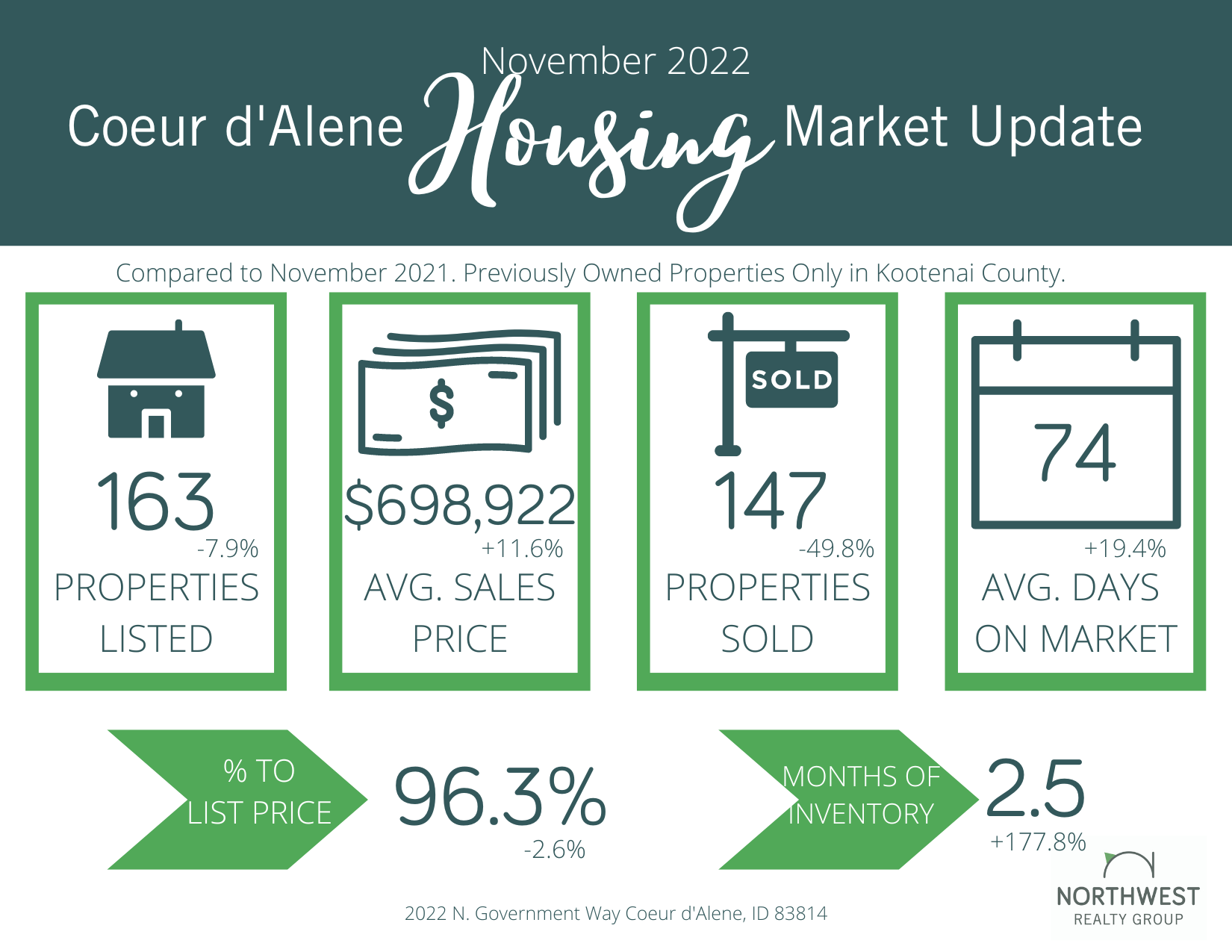
Nov 2022 Coeur d'Alene Real Estate Area Market Update


Nov 2022 Coeur d'Alene Area Real Estate Market Update

  • New listings- 163 Down 7.9%
  • Pending listings- 130 Down 38.7%
  • Sold listings- 147 Down 49.8%
  • Days on Market- 74 Up 19.4%
  • % To List Price- 96.3% Down 2.6%
  • Monthly Supply- 2.5 Up 177.8%
  • Average List Price- $698,922 Up 11.6%
These statistics represent previously owned homes in Kootenai County.
In a nut shell, interest rates have increased the past 6 months so that has cooled off the market. There is more inventory and buyer demand is low so sellers are having to negotiate. Our average purchase price has increased 11.6% from this time last year. 
Posted in Market Updates
Dec. 5, 2022

What to Do if You Can't Find a Home

What to do if you cant find a home

Finding a home in a hot market can be challenging. Supply is limited, and bidding wars are common with demand so high.  You may find yourself up against dozens of buyers, making it hard to snag the home — and at a price you can afford. It’s important not to lose hope, though. Despite the competitive market, there are ways to find (and buy) your dream home.


Are you having trouble with your home search? These tips might help:


Get pre-approved for your mortgage.

Having pre-approval is critical in a highly active housing market. It could give you a leg up over other buyers, and it can help you gauge your budget more accurately.


Expand your search area.

Branching out a little often helps open more inventory — and it may reduce your competition. If your lifestyle allows for it, you might even want to try looking in more rural areas.


Change your ideal property type.

Rather than only focusing on single-family homes, what about searching for townhouses, condos, and duplexes too? If you choose the latter, you might be able to rent out the other half to help cover your mortgage.


Shop under your budget.

Looking for properties well under your maximum budget allows you to bid comfortably above list price and beat out other buyers — without risking your financial standing.


Look into building or renovating.

Maybe you’d like a new construction home instead of buying an existing house. Or you can look to fixer-uppers and plan to renovate the home before moving. Just make sure you talk to your lender about loan options, as your choice may change what type of mortgage you need.


Do you need help on your home search? Get in touch today.


Laurel Jonas

208-758-9000

Northwest Realty Group

208HomesForSale@gmail.com

Posted in Buying A Home Tips
Nov. 30, 2022

Build a Solar Greenhouse to Elevate Your Garden

Build a solar greenhouse to elevate your garden_Laurel Jonas Blog

Growing your own fruits and veggies is a rewarding pastime — and it’s good for your body, mind and spirit. And when you have a solar greenhouse, you can reap those positive benefits all year long while also caring for the environment.

What Is a Solar Greenhouse?

All greenhouses use the sun, but solar greenhouses harness that solar power for more than just growing tasty veggies. Traditional greenhouses made of glass or plastic usually rely on fossil fuels to provide additional heating needs during colder months. A solar greenhouse, on the other hand, creates a warm, nurturing environment all year long using nothing more than natural materials, energy-efficient design and the power of the sun.


How to Build a Solar Greenhouse


If you’re ready to get your hands dirty, here’s what you need to know to build your own little piece of gardening heaven.


Pick the perfect spot

Before strapping on your tool belt, make sure the patch you pick receives optimal sun exposure. Situate your greenhouse so that it faces south, with a slight orientation to the east. This helps maximize early morning sunlight and offers some protection from overheating in the late afternoon. It also ensures full sun exposure during the winter when the sun rises in the southeast.

Create a workable footprint

Determine the square footage you need and plot out the layout of your garden. Consider things like the room you will need to comfortably move between planting beds and rows. The overall size of your greenhouse should be based on how much planting area you need to produce the amount of food you want to grow.


Select the right materials

Because solar power runs the whole show, you need to use a material that will let at least 70 percent of the light through (transmissivity) while minimizing energy loss (R-value). You will maximize your garden’s production when you have a balance between those two variables. Polycarbonate is a sustainable material that can provide the appropriate amount of transmissivity and R-value.


Insulate your space

To keep your garden thriving all year long, your greenhouse needs to be able to trap solar energy and provide heat during cold weather. This is where that R-value can really make a difference. Select the level of thermal resistance you need based on the number of growing seasons you plan on. The northern wall needs to be fully insulated — but if you’re in a colder climate, you may want to insulate the east and west walls as well as the floor and the perimeter. Speak to a local nursery or greenhouse designer to find out the R-value and insulation recommendations for your climate.


Let some air in

Ventilation is a crucial part of keeping your plants healthy and cooling down your greenhouse. Fresh moving air also helps cut down on pests and diseases. The most sustainable solution is to maximize natural ventilation: install intake vents down low and place exhaust vents up high. Cool air will enter through the intake vents, rise as it warms, and exit through the exhaust vents. You can control ventilation with automated solar-powered vent openers and/or exhaust fans.


Use thermal mass

Materials that are capable of storing heat and energy supply thermal mass to your greenhouse. Thermal mass is especially important if you plan to grow throughout the winter. Water, stone, used concrete and cob are all good sources of thermal mass. Depending on your space constraints, you can install large drums of water or use stone or cob on the floor or north wall.


Get soil and irrigation right

A greenhouse creates an environment that makes plants grow faster, bigger, and longer. To support optimum growing conditions, you need the right soil. Do not build on a concrete slab as it will prevent access to nurturing subsoils. Instead, build on the ground and add compost and mulch to keep soil full of nutrients. Use a rainwater drip irrigation system to further harness the power of nature. Rainwater is free of chlorine and other additives and naturally contains nitrogen, which your plants need.


Now that you know the basics of building a solar greenhouse, look for plans that meet your needs and get started. Happy planting!

Laurel Jonas

208-758-9000

Northwest Realty Group

208HomesForSale@gmail.com

Posted in Home Tips
Nov. 28, 2022

What happens when you receive a low appraisal

What happens when you receive a low appraisal

Options for a Low Bank Appraisal

You’re on your way to buy a new home, congrats! You’ve found the one you love… your offer has been accepted… you’ve completed the inspection with little-to-no issues… you’re almost there, right? There’s just one more hurdle before you’re ready to sign on the dotted line and finance your home—the home appraisal.

If you’re seeking a mortgage, you must have your prospective home appraised for a value that is higher than your purchase price. So, what happens if your bank appraisal comes in lower than that agreed-upon price? Are your home purchasing dreams destroyed? Do you have to start your home search all over again? Hold those negative thoughts!

Even when your bank appraisal comes in low—which can happen for several reasons that may or may not include a bidding war or even an inexperienced appraiser—you still have a few options when it comes to purchasing the home.

Here are five ways to move forward when you receive a low bank appraisal:

1. Make Up the Difference

When a home appraisal comes up short, a simple solution is to pay the difference up front. This option can work for buyers who are ready to put more money down for their new home. However, for a buyer who is already putting down as much as they can, making up the difference due to a low home appraisal may sound like an impossible plan.

2. Work it Out with the Lender

Even if a buyer cannot afford to put any more money down on a new home, they may be able to pay a little extra monthly to cover the difference in price. If a buyer is willing to pay private mortgage insurance until they meet agreed-upon mortgage terms, lenders may still be willing to offer financing.

3. Negotiate a Lower Price

If you think your bank appraisal came in low for good reason (or even a not-so-great reason), you can try to renegotiate the home purchase price to meet the appraisal. If a home seller is motivated and does not have other offers to consider, they may be more than happy to settle for the appraiser’s price. After all, it can’t hurt to ask, right?

4. Request a New Appraisal

If you think your low bank appraisal missed the mark completely, you can ask your lender for a new appraisal to confirm the findings. A second appraisal could come back over the agreed-upon purchase price. The result? A buyer’s home purchase moves forward with no issue!

5. Walk Away

Though it may seem like the worst-case scenario when it comes to a home purchase you’ve been working toward, if a buyer is trying to stretch their budget to make up the difference between a low bank appraisal and purchase price, the best solution may simply be to cancel the transaction.

Certainly, receiving a low bank appraisal can be discouraging, but that news does not have to ruin your home ownership dreams. If you’re a buyer trying to deal with a low appraisal, be sure to evaluate all your options before choosing the best path forward.


Laurel Jonas

208-758-9000

Homesforsale@gmail.com

HomesForSale.com

Northwest Realty Group

Posted in Buying A Home Tips
Nov. 22, 2022

5 Homebuying Misconceptions to Avoid

5 homebuying misconceptions to avoid_Laurel Jonas Blog

It’s common for both first-time homebuyers and experienced homeowners to feel overwhelmed by the process of purchasing a house. Plus, myths and misconceptions often make the experience even more confusing.


Myths like: Renting is cheaper than buying. You need a credit score of 700 to get a loan. You shouldn’t buy in a seller’s market. Have you come across any of these?


If you’re thinking of buying this year, don’t let these misleading ideas deter you from your goals.


Myth #1:

You need a certain credit score. While mortgage programs do have credit score minimums, you’d be surprised at how low those go. With an FHA loan, you may be able to get financing with a score of 500. (Just know that your score may also affect the interest rate and terms of the loan.)


Myth #2:

You should only buy during certain seasons or under certain market conditions. While competition may seem fierce lately, that doesn’t mean you shouldn’t buy a house. As long as you choose a home you can afford and one that will grow in value, it’s still a smart long-term investment. 


Myth #3:

It’s cheaper to rent than buy. Home prices have been rising lately, but rents have jumped significantly, too. Since homeownership allows you to build equity and wealth over time, it’s important to crunch the numbers before assuming you’re better off renting.


Myth #4:

You should get a mortgage from your bank. Your bank should definitely be on the list, but don’t limit your shopping to just them. Get quotes from several banks and lenders to ensure you get the best deal.


Myth #5:

You should waive your inspection to win a bidding war. Waiving your right to an inspection might help you beat out other offers, but it can also come back to bite you. Inspections often reveal costly and even dangerous defects, and you’ll want to know about these before deciding to buy.


Have questions about buying or selling a home? Get in touch today.

Laurel Jonas

208-758-9000

Northwest Realty Group

208HomesForSale@gmail.com

Posted in Buying A Home Tips