Enjoy helpful home buying and selling tips as well as market updates, community events and local love.

Nov. 14, 2022

How to Envision a New Home to Accommodate Your Home Office

How to Envision a New Home to Accommodate Your Home Office

How to Envision a New Home to Accommodate Your Home Office

If you have a business from home then you know that this can come with certain benefits as well as a few disadvantages if not planned properly. For example, if your business is growing faster than you thought it would and you haven't catered for this change in time, you might find yourself facing the dilemma of having to upgrade your home or move to a new home to accommodate your thriving business. Here's how to determine what steps you need to take when considering both of these options.

What will the finances look like?

Suppose you decide that the better option is to sell now and use the profits to purchase bigger accommodation. Then you have to start off with getting your current property appraised to see what the market value is for it and what opportunity it presents when it comes to making a profit off of the sale. 

Looking at potential properties

Since your new living quarters are going to look different from what you're living in right now, it might take a bit of time to find your ideal property. Factors you might want to consider when searching for a bigger home might include a separate office area, ample parking, a separate entryway and exit, sufficient power, and an adequate plumbing system in place if you have to have an extra bathroom for customers or clients. Since the search for your ideal property might be quite extensive, enlisting a realtor to help you with the research process might be an easier option, as they will have access to a database of properties that might meet your criteria more closely. 208HomesForSale can help you narrow down your search quite considerably if you are looking for suitable properties in the North Idaho area.

Crossing of the legal to-dos

Once you find the home of your dreams you need to find out if operating a business from home is permissible. Here, you would be looking into what the zoning law says to start an LLC in Idaho from your home by contacting your local municipality. You may also need to apply for additional licenses or certificates depending on the industry you're in. Apart from this, the next step would be to register your home business as such. This is particularly important because different states will usually have different filing requirements  (that is, if you intend to move out of state). If costs are an issue for you, you could register your business yourself with a federal agency. Or you can choose to bypass all this effort and use a formation service to do all this leg work on your behalf.

Marketing your home-based business

Having a solid marketing plan in place is going to help your business build a name for itself quickly. This is especially important for a home-based business as you might not have the visibility you would have in an office block, for example. One of the ways you can put your best foot forward is by adding a banner to your website to catch the attention of visitors as they land on your site. With an online banner maker, you can make use of the templates provided and just add your own twist to them depending on the colors, animation, and videos you want, including the text you want to highlight.

The above pointers should hopefully guide you in the right direction if you feel like the time is now to make that move for the success of your business. Researching as much as you can about what you want in a property versus what you don't want is also going to help you reach a conclusion much quicker.


Written by Seth Murphy

http://papadiy.com/
seth@papadiy.com

Image via Pexels

Laurel Jonas
Northwest Realty Group
208-758-9000
208HomesForSale@gmail.com
208HomesForSale.com
Posted in Home Tips
Nov. 9, 2022

How Does a Court-Confirmed Probate Sale Work in Real Estate?

How does a court confirmed probate sale work in real estate

Properties sold in probate court can be a good deal, as they’re often priced lower than other homes. But there are risks, and probate sales often take longer than traditional real estate transactions. If you’re an active real estate buyer, at some point you’ll likely come across a probate sale. As a result, as with short sales, some buyers keep the probate sales at bay and their real estate agents discourage them from getting their hopes up on actually buying a home through probate courts. Here’s the story on probate sales in real estate.


Why a home is sold through probate court

A home is sold in probate court when someone dies intestate or without bequeathing their property. When that happens, the state takes over and administers the property’s sale. The court wants to be certain the property is marketed and sold at the best possible price. To ensure this, the court requires certain steps, processes and procedures be followed. Probate laws can vary from state to state, but any good real estate agent should be sufficiently knowledgeable about the ins and outs of probate sales.


Marketing a probate sale

In a probate sale, the property is marketed just like any other property. The probate attorney or the estate representative will hire a local real estate agent, sign a listing agreement, and show the property, just as they would a traditional listing. Generally, the list price is based upon the listing agent’s suggestions as well as an independent appraisal ordered and issued by the court.


Making an offer

An interested buyer may make an offer on the property at any time. However, in the case of a probate sale, the offer must be accompanied by a 10 percent deposit. The estate representative will then accept or counter the offer, just like any other sale. The offer is subject to the court’s confirmation. Even though the seller may have accepted a buyer’s offer, the seller is not committed to that buyer or their offer. The estate representative, through their probate attorney, will then petition the court to confirm the sale. A future date is chosen for the sale to be confirmed in the court.


Playing the waiting game

Once the sale date is determined, the parties now must wait a minimum of 30 to 45 days. During this time, the court requires that the property be properly advertised and marketed with the new accepted price. In California, for example, the court will take that accepted offer and raise it by 5 percent plus $500. The total becomes the new probate price to be marketed.


Going to court

In order for the sale to be confirmed, the court requires that the new buyer, plus any other interested party, come to probate court to confirm the sale. The property is then sold auction style with the opening bid being (in the case of California) the accepted offer price plus the 5 percent, $500 increase. Sometimes multiple buyers show up to bid on the property in increments of $5K. If nobody shows up to bid on the home, the first buyer gets the property for their original offer price. If the property is sold to one of the bidders, they must immediately hand over a deposit of 10 percent.


The deposit may not be refundable

There are some things for buyers to be aware of when moving forward on a probate sale. Many times, the 10 percent deposit that’s required with the offer is not refundable unless the original buyer isn’t the final court confirmed buyer. Also, since the seller is deceased, there usually isn’t anyone to disclose a previously leaky window, illegal work done on the property, plans for a major change to the neighborhood, or anything else that may negatively affect the property’s value. That’s why probate sales can be risky.

An early inspection is your best defense

Any serious buyer should have the property inspected from top to bottom before writing an offer. Yes, you’re gambling the price of the home inspection without knowing if your offer will even be accepted, or if you’ll be outbid by someone else in probate court. But would you rather gamble the cost of an inspection — or the cost of a house?


Laurel Jonas- REALTOR®

Northwest Realty Group

2022 N. Government Way Coeur d'Alene, ID 83814

208-758-9000

208homesforsale@gmail.com

208homesforsale.com


Posted in Buying A Home Tips
Nov. 3, 2022

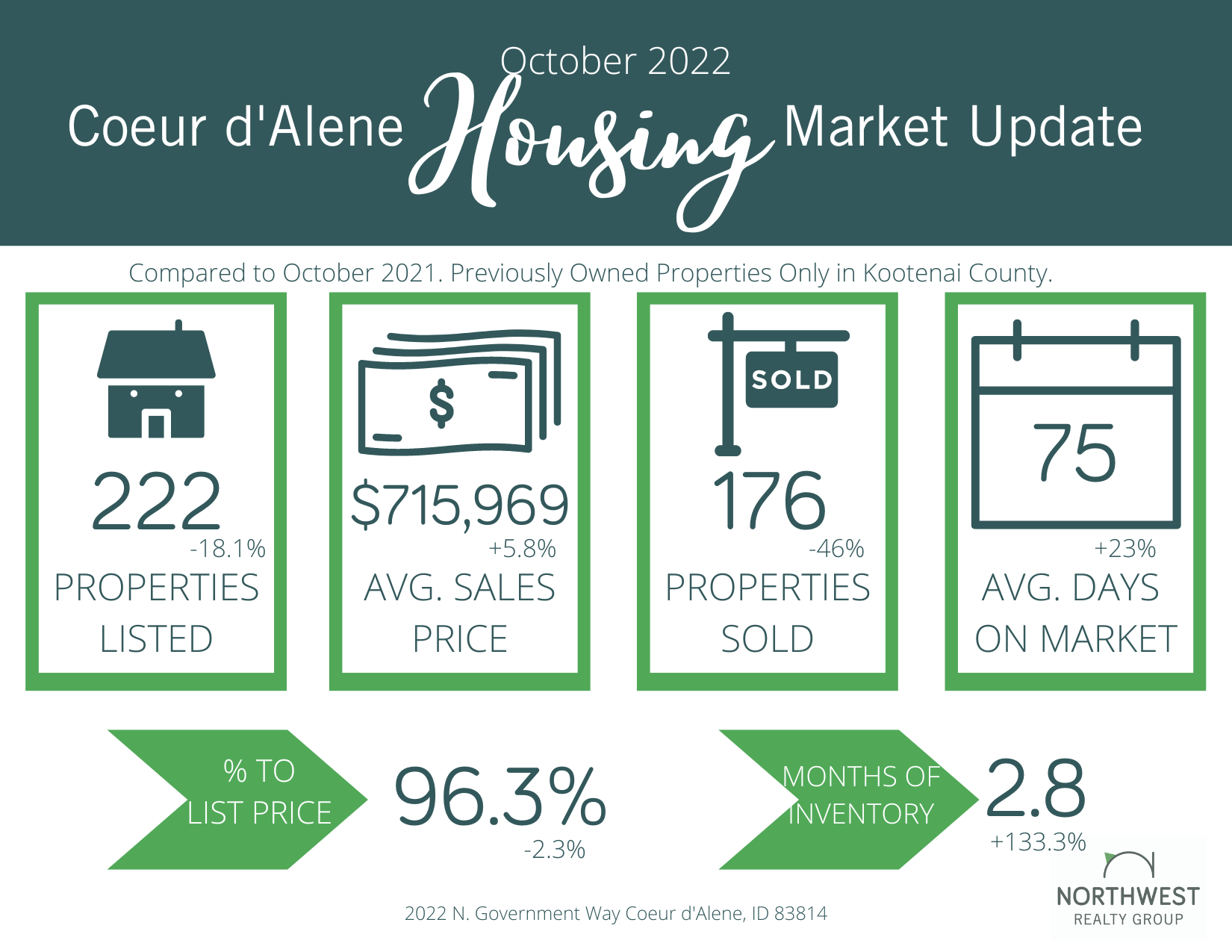
October 2022 Coeur d'Alene Area Real Estate Market Update

October 2022 Coeur d'Alene Area Real Estate Market Update

  • 222 Homes were listed October 2022. That's down 18%
  • 176 Homes Sold last month. That's down 46%
  • Average Sales Price $715,969 which is up 5.8%
  • Average Days on Market: 75. That's up 23%
  • Last Month We Had 2.8 Months of Inventory. This is up 133.3% compared to Oct. 2021.
  • Sellers Are Receiving An Average of 96.3% Of Their List Price. That's down 2.3%

* These stats are based on previously owned properties in Kootenai County


Inventory is up and closed sales are down. With this market adjustment, it takes the right skills and knowledge to sell a home with competition so high and less buyers. I am that agent. I've been a full time agent since 2007 and also a real estate author. Contact me today to discuss your situation and options


Laurel Jonas

Northwest Realty Group

208-758-9000

208HomesForSale.com

208HomesForSale@gmail.com

Posted in Market Updates
Nov. 2, 2022

5 Gifts To Leave For Your Old Home's New Owners

5 gifts to leave your old home's new owners

Selling a home is an emotional event. You are leaving behind a house filled with memories and venturing off to someplace new. The people buying your home are excited to create their own memories in a home that you loved for so many years. Welcome them with a thoughtful gift that will leave a lasting impression.


Here are some ideas for gifts to leave for your home’s new owners.

Personalized Key Rings: Mark this milestone in the new owners’ lives by giving them a special key ring. Engrave it with their initials, the date of the move, or even a special message from you. Not only is this thoughtful, but it’s a practical gift as well.


Mailing labels and stationery: Personalized gifts go a long way. Create mailing labels with the owners’ names and new addresses; if you want to go the extra mile, create personalized stationery for them as well. Leave these paper gifts on the kitchen counter with a nice note to surprise the owners.


Monogrammed Doormat: Doormats are something that may not be at the top of a new homeowner “to-buy” list. Give them a monogrammed one or one that fits well with the decor of the home. They will surely appreciate this gesture.


Practical Items: If you’re skeptical about buying personalized gifts, stick to practical home items. Things like smoke and carbon monoxide alarms, unpacking supplies, or even a utensil organizer are useful to new homeowners. They’ll be so busy when they first move in, and these are essentials that they should have immediately.


A Neighborhood Guide: Write a detailed list of your favorite places in the neighborhood. Mention your favorite restaurants, boutiques, gyms and more. They’ll love having your recommendations on hand when they start to explore!


All of these gestures are incredibly kind and memorable. It’s a nice way to welcome new people into the home and neighborhood you have loved for so long.


Laurel Jonas- REALTOR®

Northwest Realty Group

2022 N. Government Way Coeur d'Alene, ID 83814

208-758-9000

208homesforsale@gmail.com

208homesforsale.com

Posted in Selling Tips
Oct. 26, 2022

The Weird World of Unsolicited Offers

The weird world of unsolicited offers

If you’re one of those lucky people who own a home in a “hot” area, it’s a pretty sweet feeling. You made a good real estate call. If you decide to sell, all signs point to it being an easy and lucrative transaction. It’s all enough to make a person do a Snoopy-style happy dance. But lately, there’s a downside to being in a desirable property: an avalanche of unsolicited offers.


When eager buyers go too far

Many homeowners are reporting that these “sell me your house!” requests are pouring in via phone calls and text messages, even if their number is unlisted. Owners are finding letters and notes left in their mailbox or slipped beneath their front door; the words “all cash!” often figure prominently. Residents even report that they’re receiving postcards with photos of their home and the words “I’m ready to buy your house!” Yup, someone stood outside and took a picture without their knowing it. Creepy!


Occasionally, these inquiries come from people who actually want to live in your home very, very much. Maybe they love the school district or your charming Belgian block driveway. By personally connecting with you, they might catch you at the right moment if you’re pondering a move. It’s how some people get a dream home when housing stock is in short supply. More often, though, these inquiries are from real estate investors looking to flip your house for the largest possible profit.


Understand who is behind the outreach

“This is actually a big problem in Nashville right now,” says Cara Berkeley, creator of the money blog Penny Polly. “Because the local real estate market has experienced record-growth in property values and sales, there are a lot of investors on the market looking to shake out their next fix-and-flip. Since there is so much money to be made, they are very aggressive in their search for new homes to purchase—calling, leaving notes on doors, and even texting.”


So who are these people, exactly? While some may actually intend to renovate the house then sell it, others are just hoping to buy low and sell high to make some quick, easy, effort-free cash.


“Most of these offers come from what the industry calls ‘wholesalers’ or ‘bird dogs,’” explains Bruce Ailion, a Realtor Emeritus with Re/Max Town & Country. “These are typically people who do not have the money to close on the home. They only seek to get it under contract and quickly sell it to someone else for more, never using any of their own money.”


These are the kind of tactics being taught in such courses that claim to help participants “become a real estate millionaire overnight!” The people who call your home are also likely to be the ones posting “we buy houses” flyers on power poles.


“Title flipping for profit is one of their techniques,” Ailion explains. “A title flip will net a profit from a few thousand dollars to over a hundred thousand.”


Are these offers legit or a scam?

While these offers may well be legal, not everyone views them as fair. They dangle the lure of a quick and convenient transaction, with cash landing in your bank account ASAP.


However, “It would be very rare for one of these unsolicited buyers to offer a fair price for a property,” cautions Ailion. “Therefore, buyers should be very wary of these offers.” In fact, homeowners receiving these solicitations sometimes report being offered no more than 70% of their home’s market value.


The “bird dogs” behind these letters typically hope to find someone with a level of desperation or ignorance about the property’s actual value. Those are the ones who actually bite. Granted, there are rare situations where this kind of offer might make sense. Say your home needs major work done. (Perhaps the foundation is cracked or the roof is on its last legs.) Maybe you’d rather just get out of your house fast. This title-flipping scenario could save the day. But for the vast majority of people it’s important to work with a reliable, knowledgeable real estate agent. That person can tell you the true value of your home so you don’t lose a chunk of money. They can also respond to these inquiries on your behalf.


Coping with the invasion of privacy

Let’s not overlook how uncomfortable it can be to receive these unsolicited offers. It’s an annoying intrusion and makes some people feel as if they’re being stalked. Homeowners could post “private property,” “no trespassing,” or “no solicitation” signs. Still, the prospector will probably resort to contacting the homeowner by mail or email (unsubscribe if possible). If they continue to reach out by phone, most services allow blocking of unwanted callers. Use it!


Laurel Jonas- REALTOR®

Northwest Realty Group

2022 N. Government Way Coeur d'Alene, ID 83814

208-758-9000

208homesforsale@gmail.com

208homesforsale.com

Posted in Selling Tips
Oct. 25, 2022

1352 W Miss Hana Ave, Post Falls, ID 83854

If you are looking for a home with a shop and parking? This may be the home for you. Not only is it highly upgraded but it sits on a .37 acres.  Click on the link below to view the listing with pictures or view our walk through video below as well.

1352 W Miss Hanna Post Falls ID 83854

Here are the specs of this home:

4 Bedroom

2 Bathroom

2172 sq ft

Built in 2022

Lot Size: .37

Shop Size:  30'x40'x14' shop with a 16' wide by 12' tall shop door

Garage Space 3

Taxes $1,030

Lot Features Level Interior Features Central Air, Dryer Hookup - Elec, Gas Fireplace, High Speed Internet, Smart Thermostat, Washer Hookup

Appliances Dishwasher, Gas Water Heater, Microwave, Range/Oven - Gas Heating Fireplace, Forced Air, Furnace

Kitchen Features Kitchen Island, Walk-In Pantry

Exterior Features Covered Patio, Covered Porch, Curbs, Fencing - Partial, Landscaping, Lawn, Lighting, Paved Parking, Rain Gutters, Sidewalks, Sprinkler System - Front

Exterior Cedar, Hardboard, Lap Siding, Stone, Wood Water City Sewer City Sewer Garage Description

School District Post Falls - 273

https://www.208homesforsale.com/property/22-7858/


Oct. 24, 2022

When selling your home, Be flexible with your schedule

I cannot emphasize this enough: When selling your home, be flexible with your schedule! Buyers want to view the home on THEIR schedule. If you as a seller make it hard and inconvenient to view the home, many buyers will pass it all together.  You want as many buyers through the door as possible. You want to think of each buyer as a possible offer. By reducing the time potential buyers can view it, you are reducing the number of people looking.


Laurel Jonas

208-758-9000

Northwest Realty Group

208HomesForSale@gmail.com

208HomesForSale.com

Posted in Selling Tips
Oct. 19, 2022

4 Tips to Disguise Your Propane Tank

4 tips to disguise your propane tank

Are you one of the 50 million Americans relying on propane gas to heat your home this winter? Well, then kudos are in order! Using propane not only reduces greenhouse gas emissions, it also helps you save on energy costs. But there is one major con when it comes to using propane as your primary energy source: that enormous monstrosity in your yard: the propane tank.


Depending on how big your home is, these oblong tanks can range in size from 120 gallons (almost 6 feet long by 2 feet wide) to over 1,000 gallons (about 15 feet long by 3.5 feet wide). Here’s how you can take your propane tank from eyesore to decor.


1. Paint your tank

Yes, you can give your propane tank a colorful makeover! Adding some color and design just might make you like the way it looks. And this nifty transformation will set you back only the cost of a few cans of primer and paint. Painting your tank is a good strategy because it doesn’t require a lot of money or effort. Everybody looking at your tank will still know what it is, but it won’t look as bad.


Depending on the overall outdoor aesthetic of your home, you may choose a classic natural color that blends into your yard, such as brown or green. Or you can opt for a more eclectic design. Just keep in mind that your county or propane supplier might have certain restrictions on your color choices. For example, it may advise against painting your tank a dark color if it gets lots of sun. So always be sure to check with the supplier before crafting your perfect propane tank masterpiece.

2. Fence in your tank

Building a fence is another great option for disguising the eyesore that is your propane tank. And while it will cost you a few more bucks than a simple paint job, it can result in you not having to see the tank at all. Fencing a propane tank in is an easy DIY option. You can buy a ready-made fence or build your own. You can then hang planters on the fence to make it more aesthetic. Remember to check with your local regulatory authorities before you start, as some municipalities only allow you to add a fence on two sides of the tank while others may not let you do it at all.


The cost of fencing in your tank will vary based on its size and how much you’re legally allowed to cover. According to a fencing cost guide from HomeServe, you should plan on spending anywhere from $10 to $35 per linear foot on materials if you choose to do it yourself. However, if you prefer to have a ready-made fence installed, prepare to spend $15 to $60 per linear foot.


3. Landscape around your tank

Painting or fencing not your style? Then you might try adding some lush tank-covering greenery. If you’d rather keep the tank as invisible as possible while still striving to make the area look beautiful, add some landscaping. Landscaping like shrubs or ivy—especially when accompanied by a small fence or lattice—can make the enclosure feel like a natural fit into the exterior of your home. Plan on spending a few hundred dollars to buy plants that are large enough to disguise your propane tank properly.


4. Bury your tank

While it’s probably the most expensive option on this list, burying your tank is a great way to go if you don’t want to see even one bit of it in your yard. To bury a 500-gallon propane tank, you’ll need to dig a hole approximately 5 feet deep, 5 feet wide, and 10 feet long. Make sure you place the tank in the sand for drainage and backfill it with sand or clean fill to prevent damage to the coating. You’ll also need to keep a few inches exposed to allow service access to valves and regulators.


Unless you love digging, it’s best to leave this job to the pros. You’ll also need to budget anywhere between $1,600 and $2,100 to get the job done. And remember to always check with your propane company before changing anything about your tank.


Laurel Jonas- REALTOR®

Northwest Realty Group

2022 N. Government Way Coeur d'Alene, ID 83814

208-758-9000

208homesforsale@gmail.com

208homesforsale.com


Posted in Home Tips
Oct. 17, 2022

What is a Solarium vs Sunroom?


Whether you’re looking to soak in as much daylight in your backyard in Tampa, FL, or enjoying your coffee on a rainy day in Seattle, WA, solariums can be a unique and gorgeous addition to your home. However, is a solarium the right investment for you? Or, would you be better off with a sunroom or a greenhouse, and what’s the difference between them anyways? Read on to find out what a solarium is, the pros and cons of adding a solarium to your home, and if it’s the right choice for you.


What is a solarium?

A solarium, also known as a conservatory, is a room made entirely out of glass. Intended for year-round use, solarium walls are made out of inch-thick double pane glass, maintaining energy efficiency while keeping out some of the cold and heat. You’ll be able to enjoy the perks of being outdoors without the weather dampening your plans, all within the comfort of your home.


What’s the difference between a solarium vs sunroom?

The difference between a solarium and a sunroom is quite simple – it’s down to the amount of glass used in its construction. While a solarium is made almost or entirely out of glass, a sunroom is built with large windows and a ceiling made with other materials. Sunrooms may have fans and insulation, making them usable year-round depending on the building materials used. 


Should I choose a sunroom over a solarium?

Depending on what you’re looking for, a sunroom may be more favorable since it’s generally cheaper to install and maintain. Although sunrooms are typically built for warmer weather, like spring and summer months, you can install additional upgrades such as heating and cooling systems to make them usable living space year-round. Sometimes, these sunrooms are called a “four-season room.” Sunrooms typically also require less maintenance and are often less expensive to build. The cost of a sunroom ranges between $8K to 50K, compared to $30K to $75k for a solarium. In some cases, you may be able to purchase a sunroom kit for a DIY project, cutting the costs down further. 


What’s the difference between a solarium and a greenhouse? 

A greenhouse is similar to a solarium, but their uses are often different. While you can use a solarium for various purposes, including growing plants, a greenhouse is typically dedicated to growing plants. Unlike solariums, greenhouses are made of either glass or translucent plastic. They’re designed to shelter plants and provide them with the optimal light to grow. So, if you’re looking for a place to relax or host guests, a greenhouse may not be the right option for you.


How much does a solarium cost?

A solarium can cost anywhere from $30K to $75k, depending on the space you want and the building materials needed. Since a solarium requires a steel structure to support the glass walls, ceiling, and double-pane glass, solariums are typically more expensive than a sunroom or enclosed patio. However, you’ll have an unobstructed view of the sky and your surroundings.


What are the pros and cons of adding a solarium?

When it comes to building a solarium, there are advantages and disadvantages to consider. 

Pros of a solarium addition:

  • Unobstructed views: One of the main pros of a solarium addition is the sweeping views of the outdoors. With glass walls and ceiling, you can watch the snow fall or enjoy the views on a sunny day, without anything blocking your views.
  • Protection from the weather: When considering a solarium, you may be wondering if it makes more sense to sit outside rather than in a glass enclosure. But imagine it’s raining during the summer and you want to enjoy the sound of the rain without getting wet. You can do that in a solarium. Solariums offer a layer of protection against the elements. That way you can enjoy an afternoon watching the rainfall from within the comfort of your home, but feel more closely connected to nature. 
  • Multi-use: Solariums can be used in a multitude of ways, whether you’re using it as a place to read, practice outdoor yoga without being outside, stargazing, or even growing out of season plants. You can make use of a solarium in any way you desire.

Cons of a solarium addition:

  • Maintenance: With an all-glass structure comes a lot of care. It can be difficult to keep a solarium’s views spotless when it’s constantly exposed to the elements.\
  • Heat: Solariums can often get quite hot. While this can be particularly beneficial for those using the space as a greenhouse, it can sometimes be too hot to enjoy the view. You can mitigate this issue by installing a vent fan, allowing the hot air to filter out. You can also purchase retractable screens to block out some of the sun’s rays.
  • Price: Compared to other types of sunrooms, solariums are usually the priciest. This is partly due to the type of building materials and the cost of installation. If you’re looking for a less expensive alternative, consider a sunroom addition or a DIY sunroom kit.


Will a solarium or sunroom add value to my home?

With any home improvement project you take on, the ultimate goal is to increase the value of your home over time. Sunrooms only have a 97.2% sale-to-list ratio. This means that homes with sunrooms are not sold above list price and don’t necessarily increase the value of your home. However, while solariums and sunrooms can be expensive, they may be the right investment for you if it meets your needs, day-to-day life, and aligns with your budget. Home trends are constantly changing, so what may increase your home value now may decrease it in the future and vice versa. 


Is a solarium right for you?

No matter what home improvement project you decide to undertake, choosing the right one takes time and consideration. When deciding between a solarium and a sunroom, determine what’s most important to you and if it fits into your budget and lifestyle.


Laurel Jonas

208-758-9000

Northwest Realty Group

208HomesForSale@gmail.com

Oct. 17, 2022

Pack your your home, Less is more


 If you’re facing a move or just tired of managing your family’s enormous amount of stuff, you can create a plan to help your family move on from under the clutter.


The average weight of items you have in each of the rooms in your home is 1,000 pounds. So, for a four-bedroom home with a kitchen, dining room, family room, living room and extra storage areas, all your belongings could top 8,000 pounds. That’s four tons, or for comparison, around the average weight of an elephant.


The cost of moving that mountain of goods is high, so the more you can downsize, the less it will cost you to move when it comes time to relocate.


Buying stuff is easy, but storing, managing, and clearing it out is the hard part. Having to deal with overflowing drawers, stuffed closets, jammed cabinets, cluttered spaces, and packed garages/basements/attics can lead to anxiety for many. Before you lose your cool, consider some proven methods to make your home more peaceful and less cluttered.


Corral Everything

Counters, tables, the floor, and other flat surfaces are not storage areas.


If there’s no room for a new item to have a permanent home, reconsider what you’re storing in drawers, closets, cabinets, and other storage areas to make room for it.


Don’t just box up old or unused stuff and take it to be stored off-site at a storage rental facility. Once items are boxed up and out of sight, you’re unlikely to use, review or deal with them, resulting in costly monthly storage rental fees.


Curb Purchasing

One great rule to institute is for every item brought in (whether it’s a gift or purchase), another item must leave the premises either by selling it, donation to a charity, gifting to another person, or being thrown away.


Determine where a new item will live in your house before you purchase it. Every item you don’t buy saves you not only money, but the mental stress of dealing with it. Eliminating purchases also avoids debt if you carry credit card balances.


Before you purchase something, investigate whether you can borrow it first. For books, music, and videos, check out your library.


Clear Items Daily


  • Unpack boxes as they’re delivered.
  • Sort through the mail only once and take immediate action on items that require it.
  • Put away groceries and other purchases promptly.
  • Dispose of packaging and bags appropriately and promptly.
  • Clean Regularly


Don’t think of cleaning as a singular event. It should be an ongoing regular task. Your stress level will go down because you’ve stuck with a schedule — vacuum on Tuesday, clean toilets on Wednesday, scrub showers on Thursday, etc.


Don’t just make donations of goods to charities around the holidays or end of the year. Go through your belongings with a critical eye regularly and donate smaller amounts more often.


Consider A Professional

If the stuff in your home is overwhelming you, consider bringing in a professional organizer. An organizer can address all your belongings, the size of your home, storage possibilities and more.


Hiring a cleaning service can also bring you happiness if you save time avoiding chores you don’t want to do or don’t have the time to complete.


Laurel Jonas

208-758-9000

Northwest Realty Group

208HomesForSale@gmail.com

Posted in Selling Tips